Study of force systems and equilibrium for Mechanical Engineering and GATE & IES preparation.
Preparation Mode
62 Active Questions
Answers & Explanations Included
📖 Study the questions before taking the quiz examination.No timer • No attempt recorded • No marks awarded
Question 1 of 62
Original Exam: GATE (2016)
A 100 N ball is suspended by a string. A horizontal pull makes the string 30° from the vertical. What horizontal force is required for equilibrium?
✓ Correct Answer: D
Explanation:
For vertical equilibrium, T cos30° = 100 N. For horizontal equilibrium, F = T sin30°. Dividing gives F/100 = tan30°. Hence F = 100/√3 = 57.74 N. The string tension and the two applied components therefore balance in both directions.
Difficulty: basicType: numerical
Question 2 of 62
Original Exam: GATE (2016)
A block is on an inclined plane with μs = 0.25 and is tied by a string that can carry at most 20 N. Given sinθ = 0.6, cosθ = 0.8 and g = 10 m/s², what is the maximum mass that can remain in static equilibrium without breaking the string?
✓ Correct Answer: A
Explanation:
At the limiting condition for the largest mass, the block tends to slide down, so friction acts up the plane at its maximum value μmg cosθ. Along the plane, T + μmg cosθ = mg sinθ. Taking T = 20 N gives 20 + 0.25(m)(10)(0.8) = m(10)(0.6), or 20 + 2m = 6m. Thus m = 5 kg.
Difficulty: intermediateType: application
Question 3 of 62
Original Exam: GATE (2018)
A uniform horizontal bar weighs 100 N. One vertical string is attached at the left end and another at the midpoint, where the bar's weight also acts. What are the two string tensions?
✓ Correct Answer: B
Explanation:
The weight of a uniform bar acts at its midpoint. Taking moments about the left-end string, the midpoint tension must balance the weight at the same location: T2(L/2) = 100(L/2), so T2 = 100 N. Vertical force equilibrium then gives T1 + T2 = 100 N, hence T1 = 0 N.
Difficulty: basicType: conceptual
Question 4 of 62
Original Exam: GATE (2020)
A bent, massless beam is hinged at P and has a roller reaction at Q on a vertical surface. A 1200 N downward load acts at R. If the perpendicular moment arms about P are 5 m for the load and 4 m for the Q reaction, what is the magnitude of the reaction at Q?
✓ Correct Answer: D
Explanation:
Take moments about P so the unknown hinge reactions at P disappear. Equilibrium requires Q×4 = 1200×5. Therefore Q = 6000/4 = 1500 N. This is a direct application of the moment equilibrium equation for a rigid body.
Difficulty: basicType: numerical
Question 5 of 62
Original Exam: GATE (2020)
A beam has an internal hinge B. The segment BC is 4 m long and carries a 10 kN/m uniformly distributed load over the segment. What vertical reaction magnitude occurs at C?
✓ Correct Answer: C
Explanation:
For segment BC, the 10 kN/m UDL over 4 m has a resultant of 40 kN acting at its midpoint, 2 m from B. Taking moments about internal hinge B: RC(4) = 40(2). Hence RC = 20 kN. The internal hinge lets the segment be isolated for this equilibrium calculation.
Difficulty: intermediateType: numerical
Question 6 of 62
Original Exam: GATE (2020)
A roller is just about to climb a curb when pulled horizontally. Which description of its free-body diagram is correct at that instant?
✓ Correct Answer: C
Explanation:
At the instant the roller is just about to climb the curb, contact with the horizontal ground is lost. Therefore the ground normal and ground friction are zero. The roller is acted on by its weight, the applied horizontal force, and the reaction from the curb edge. Hence the second description is correct.
Difficulty: intermediateType: conceptual
Question 7 of 62
Original Exam: GATE (2021)
Two identical smooth spheres of radius 125 mm and weight 100 N rest in a 400 mm wide horizontal channel with vertical walls. What is the reaction force between the two spheres?
✓ Correct Answer: D
Explanation:
The horizontal separation of sphere centers is 400 − 2(125) = 150 mm, while the center-to-center distance is 250 mm. Thus cosθ = 150/250 = 0.6 and sinθ = 0.8. For the upper sphere, the vertical component of the contact reaction balances 100 N: R sinθ = 100. Therefore R = 100/0.8 = 125 N.
Difficulty: intermediateType: numerical
Question 8 of 62
Original Exam: GATE (2022)
Two rigid massless rods meet at a frictionless pin and rest on rough ground at their outer ends. A vertical force acts at the pin. At an included angle of 90°, impending slip occurs simultaneously at both ground contacts. What is the approximate ratio μQ/μP?
✓ Correct Answer: C
Explanation:
The two rods form a statically balanced two-member system with friction at both ground contacts. Applying horizontal and vertical equilibrium to each rod, together with the limiting-friction conditions at simultaneous impending slip, gives the ratio of the required friction coefficients. Using the geometry specified in the GATE problem gives μQ/μP ≈ 5.75 (the published numerical answer is in the range 5.7–5.8).
Type: numerical
Question 9 of 62
Original Exam: GATE (2022)
A square plate is subjected to an applied couple and is supported by four alternative arrangements of identical, rigid, frictionless links. Which arrangements can maintain the plate in equilibrium under the applied couple?
✓ Correct Answer: C
Explanation:
A pure applied couple must be balanced by a resisting couple generated by the support reactions. In configuration P, the parallel links cannot provide the required in-plane resisting moment and the arrangement is kinematically ineffective for this loading. The other three arrangements can develop reaction components whose lines of action form a resisting couple. Therefore Q, R and S are the valid configurations.
Type: conceptual
Question 10 of 62
Original Exam: GATE (2024)
A rigid massless tetrahedron has forces at A along the x-axis and at B along the y-axis. Both points lie on their respective coordinate axes from the origin O. For equilibrium, what must be true about the third force applied at O?
✓ Correct Answer: B
Explanation:
The force at A is collinear with OA, and the force at B is collinear with OB, so each produces zero moment about O. Therefore moment equilibrium about O is already satisfied. Force equilibrium requires the force at O to be the negative vector sum of the x-directed and y-directed forces. Thus it lies in the x-y plane and, for nonzero components, is not along either axis.
Type: conceptual
Question 11 of 62
Original Exam: GATE (2024)
Consider four beam-support arrangements. Which arrangements are statically indeterminate according to the number of independent reaction components compared with available equilibrium equations?
✓ Correct Answer: B
Explanation:
For arrangement A, the number of independent reactions equals the three planar equilibrium equations, so it is determinate. Arrangement B has an internal hinge that supplies an additional independent equilibrium relation, again making it determinate. In C there are four reaction components but only three global equilibrium equations, giving one degree of static indeterminacy. In D the reaction count also exceeds the independent equations after accounting for the internal hinge, so D is indeterminate. Hence C and D are correct.
Type: conceptual
Question 12 of 62
Original Exam: GATE (2024)
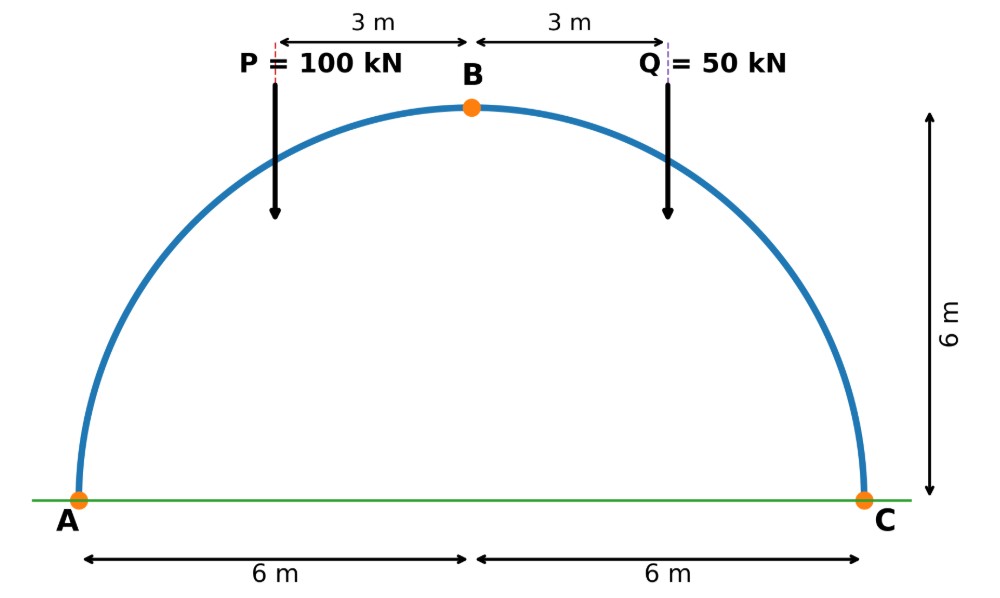
A three-hinge semicircular arch is in static equilibrium under vertical loads of 100 kN and 50 kN. what is the horizontal reaction at the central hinge B?
✓ Correct Answer: A
Explanation:
For a three-hinge arch, the horizontal reaction can be obtained by isolating one half and using the zero moment condition at the crown hinge together with the vertical support reactions. Applying the stated 100 kN and 50 kN loads and the dimensions of the original GATE geometry gives a horizontal reaction of about 37–38 kN. The corresponding rounded value is approximately 37.5 kN.
Difficulty: basicType: numerical
Question 13 of 62
Original Exam: GATE (2003)
A force of 100 N acts at a point. Its components along X and Y axes are 60 N and 80 N respectively. The magnitude of the resultant force is:
✓ Correct Answer: B
Explanation:
The resultant of two perpendicular components Fx and Fy is given by R = sqrt(Fx² + Fy²). Here R = sqrt(60² + 80²) = sqrt(3600 + 6400) = sqrt(10000) = 100 N. This confirms the given components are consistent with the 100 N force. The resultant equals the original force magnitude.
Difficulty: basicType: numerical
Question 14 of 62
Original Exam: IES (2005)
Two forces of 3 N and 4 N act at right angles to each other. The magnitude of their resultant is:
✓ Correct Answer: B
Explanation:
For two forces acting at right angles (90°), the resultant R = sqrt(F1² + F2²) = sqrt(3² + 4²) = sqrt(9 + 16) = sqrt(25) = 5 N. This is a classic 3-4-5 right triangle. The direction of resultant makes angle θ = arctan(4/3) = 53.13° with the 3 N force.
Difficulty: basicType: numerical
Question 15 of 62
Original Exam: GATE (2007)
The moment of a force about a point is maximum when the angle between the force and the line joining the point to the point of application is:
✓ Correct Answer: B
Explanation:
Moment M = F × d × sin(θ), where θ is the angle between the force and the position vector. M is maximum when sin(θ) = 1, i.e., θ = 90°. At 0° or 180°, the force passes through or away from the point, giving zero moment. At 45°, sin(45°) = 0.707, which is less than 1.
Difficulty: basicType: conceptual
Question 16 of 62
Original Exam: IES (2008)
A couple consists of two forces each of magnitude F separated by a distance d. The moment of the couple is:
✓ Correct Answer: A
Explanation:
A couple consists of two equal, opposite, and parallel forces. The moment (torque) of a couple = F × d, where F is the magnitude of each force and d is the perpendicular distance between the two forces. The moment of a couple is the same about any point in the plane. It is a free vector.
Difficulty: basicType: conceptual
Question 17 of 62
Original Exam: GATE (2010)
Three concurrent coplanar forces are in equilibrium. If two of the forces are 10 N and 15 N, the third force lies between:
✓ Correct Answer: A
Explanation:
For three concurrent forces in equilibrium, each force must be less than the sum and greater than the difference of the other two. The third force F3 must satisfy |F1 - F2| ≤ F3 ≤ F1 + F2. Here |10 - 15| = 5 N and 10 + 15 = 25 N. So 5 N ≤ F3 ≤ 25 N. The third force lies between 5 N and 25 N.
Difficulty: intermediateType: conceptual
Question 18 of 62
Original Exam: IES (2004)
Lami's theorem is applicable to:
✓ Correct Answer: D
Explanation:
Lami's theorem states: If three concurrent coplanar forces are in equilibrium, each force is proportional to the sine of the angle between the other two forces. Mathematically: F1/sin(α) = F2/sin(β) = F3/sin(γ), where α, β, γ are the angles opposite to forces F1, F2, F3 respectively. It applies ONLY to three concurrent coplanar forces.
Difficulty: basicType: conceptual
Question 19 of 62
Original Exam: IES (2006)
The resultant of two forces P and Q acting at an angle θ is R. If the angle between P and R is α, then tan(α) equals:
✓ Correct Answer: C
Explanation:
When two forces P and Q act at angle θ, the resultant R makes angle α with P. Using the sine rule in the force triangle: R/sin(θ) = Q/sin(α). Also, resolving: R·sin(α) = Q·sin(θ) and R·cos(α) = P + Q·cos(θ). Dividing: tan(α) = Q·sin(θ)/(P + Q·cos(θ)). This is the standard formula for the angle of resultant.
Difficulty: intermediateType: conceptual
Question 20 of 62
Original Exam: GATE (2009)
A body is in equilibrium under the action of three forces. Which of the following conditions must be satisfied?
✓ Correct Answer: A
Explanation:
For a body in equilibrium under three forces: (1) The forces must be coplanar (lie in the same plane). (2) The forces must be either concurrent (meeting at a point) or parallel. If concurrent, they satisfy ΣFx=0 and ΣFy=0. If parallel, they satisfy ΣF=0 and ΣM=0. The most general necessary condition is that they be concurrent and coplanar (for non-parallel case).
Difficulty: intermediateType: conceptual
Question 21 of 62
Original Exam: IES (2003)
The angle between two forces when the resultant is maximum is:
✓ Correct Answer: C
Explanation:
The resultant R = sqrt(P² + Q² + 2PQ·cos(θ)). R is maximum when cos(θ) is maximum, i.e., cos(θ) = 1, which means θ = 0°. When θ = 0°, both forces act in the same direction and R_max = P + Q. When θ = 180°, R_min = |P - Q|. When θ = 90°, R = sqrt(P² + Q²).
Difficulty: basicType: conceptual
Question 22 of 62
Original Exam: GATE (2012)
A uniform ladder of weight W and length L rests against a smooth vertical wall and rough horizontal floor. If the ladder makes angle θ with the floor, the normal reaction at the wall is:
✓ Correct Answer: B
Explanation:
Taking moments about the foot of the ladder: N_wall × L·sin(θ) = W × (L/2)·cos(θ). So N_wall = W·cos(θ)/(2·sin(θ)) = W/(2·tan(θ)). The weight W acts at the midpoint (L/2 from foot). The wall reaction N_wall acts horizontally at the top. The floor reaction acts vertically at the foot. Moment equilibrium about foot gives N_wall = W/(2·tan θ).
Difficulty: intermediateType: numerical
Question 23 of 62
Original Exam: IES (2007)
Which of the following is a necessary condition for the equilibrium of a rigid body?
✓ Correct Answer: C
Explanation:
For complete equilibrium of a rigid body, two conditions must be simultaneously satisfied: (1) ΣF = 0 (sum of all forces = 0, ensuring no translational acceleration) and (2) ΣM = 0 (sum of all moments about any point = 0, ensuring no rotational acceleration). Both conditions are necessary and sufficient for static equilibrium.
Difficulty: basicType: conceptual
Question 24 of 62
Original Exam: GATE (2006)
The resultant of a system of coplanar forces can be reduced to:
✓ Correct Answer: B
Explanation:
Any system of coplanar forces can be reduced to either: (1) A single resultant force (if the resultant force is non-zero), or (2) A couple (if the resultant force is zero but the resultant moment is non-zero), or (3) Zero (if both resultant force and moment are zero — equilibrium). So the answer is a single force or a couple.
Difficulty: intermediateType: conceptual
Question 25 of 62
Original Exam: IES (2009)
A force of 200 N acts at 30° to the horizontal. Its horizontal and vertical components are respectively:
✓ Correct Answer: A
Explanation:
Horizontal component Fx = F·cos(θ) = 200·cos(30°) = 200 × (√3/2) = 200 × 0.866 = 173.2 N. Vertical component Fy = F·sin(θ) = 200·sin(30°) = 200 × 0.5 = 100 N. So horizontal = 173.2 N and vertical = 100 N. Note: cos(30°) = √3/2 ≈ 0.866 and sin(30°) = 0.5.
Difficulty: basicType: numerical
Question 26 of 62
Original Exam: GATE (2008)
The principle of transmissibility states that:
✓ Correct Answer: A
Explanation:
The principle of transmissibility states that the external effect of a force on a rigid body remains unchanged when the force is moved along its line of action (i.e., the point of application can be changed to any other point on the same line of action). This applies only to rigid bodies and only to external effects (reactions, not internal stresses).
Difficulty: basicType: conceptual
Question 27 of 62
Original Exam: IES (2010)
Two parallel forces of 100 N and 60 N act in the same direction. The resultant force and its position from the 100 N force (total distance between forces = 1 m) are:
✓ Correct Answer: D
Explanation:
Resultant R = 100 + 60 = 160 N (same direction). Position from 100 N force: Taking moments about the 100 N force: 160 × x = 60 × 1. x = 60/160 = 0.375 m. The resultant acts at 0.375 m from the 100 N force (between the two forces, closer to the larger force). Verification: 160 × 0.375 = 60 N·m = 60 × 1.
Difficulty: intermediateType: numerical
Question 28 of 62
Original Exam: GATE (2011)
A beam of length 6 m is simply supported at both ends and carries a point load of 12 kN at 2 m from the left support. The reaction at the left support is:
✓ Correct Answer: D
Explanation:
Taking moments about the right support: R_L × 6 = 12 × (6-2) = 12 × 4 = 48. R_L = 48/6 = 8 kN. Verification: R_R = 12 - 8 = 4 kN. Check moments about left support: R_R × 6 = 4 × 6 = 24 = 12 × 2 = 24 ✓. The left reaction is 8 kN and right reaction is 4 kN.
Difficulty: intermediateType: numerical
Question 29 of 62
Original Exam: IES (2011)
The moment of a force about a given axis is zero when:
✓ Correct Answer: A
Explanation:
The moment of a force about an axis is zero in two cases: (1) When the force is parallel to the axis — the force has no tendency to rotate about that axis. (2) When the line of action of the force intersects the axis — the moment arm is zero. In both cases, the moment about the axis is zero. If the force is perpendicular to the axis but does not intersect it, the moment is non-zero.
Difficulty: intermediateType: conceptual
Question 30 of 62
Original Exam: GATE (2004)
A force system is said to be concurrent if:
✓ Correct Answer: B
Explanation:
A concurrent force system is one in which all forces pass through a single common point (called the point of concurrency). Coplanar forces lie in the same plane. Parallel forces act along parallel lines. Collinear forces act along the same line. Concurrent forces can be coplanar or non-coplanar (spatial).
Difficulty: basicType: conceptual
Question 31 of 62
Original Exam: IES (2012)
The algebraic sum of moments of all forces about any point for a body in equilibrium is:
✓ Correct Answer: C
Explanation:
For a body in equilibrium, the sum of all forces is zero (ΣF = 0) AND the sum of all moments about any point is zero (ΣM = 0). This is the second condition of equilibrium. The moment sum being zero about ANY point (not just a specific point) is a consequence of both equilibrium conditions being satisfied simultaneously.
Difficulty: basicType: conceptual
Question 32 of 62
Original Exam: IES (2013)
The free body diagram of a body shows:
✓ Correct Answer: A
Explanation:
A Free Body Diagram (FBD) is a diagram of a body isolated from its surroundings, showing all external forces and moments acting on it. These include: applied loads, weight, normal reactions, friction forces, tension in strings/cables, and spring forces. Internal forces (between parts of the body) are NOT shown in FBD as they cancel in pairs.
Difficulty: basicType: conceptual
Question 33 of 62
Original Exam: GATE (2014)
Two forces of equal magnitude F act at a point at an angle of 120° to each other. The magnitude of their resultant is:
✓ Correct Answer: D
Explanation:
R = sqrt(F² + F² + 2F²·cos(120°)) = sqrt(2F² + 2F²·(-1/2)) = sqrt(2F² - F²) = sqrt(F²) = F. Using the formula R = 2F·cos(θ/2) where θ is the angle between forces: R = 2F·cos(60°) = 2F × 0.5 = F. When two equal forces act at 120°, the resultant equals the magnitude of each force.
Difficulty: intermediateType: numerical
Question 34 of 62
Original Exam: IES (2014)
The resultant of two forces P and Q (P > Q) acting along the same line but in opposite directions is:
✓ Correct Answer: B
Explanation:
When two forces act along the same line in opposite directions, the resultant is their algebraic difference. Since P > Q, the resultant R = P - Q, acting in the direction of the larger force P. This is the principle of collinear forces. If P = Q, the resultant is zero (equilibrium). The net effect is the dominant force minus the opposing force.
Difficulty: basicType: conceptual
Question 35 of 62
Original Exam: GATE (2016)
A rigid body is acted upon by a force F at point A. This force can be replaced by an equal force at another point B plus:
✓ Correct Answer: C
Explanation:
When a force F is moved from point A to point B (not on the line of action), it must be accompanied by a couple to maintain equivalence. The moment of the couple = F × d, where d = AB × sin(θ) is the perpendicular distance between the original and new lines of action. Here θ is the angle between AB and the force F. So the couple moment = F × AB × sin(θ).
Difficulty: intermediateType: conceptual
Question 36 of 62
Original Exam: IES (2015)
For a system of coplanar concurrent forces to be in equilibrium, the necessary and sufficient conditions are:
✓ Correct Answer: D
Explanation:
For concurrent forces (all passing through one point), the moment condition ΣM = 0 is automatically satisfied about the point of concurrency. Therefore, only two conditions are needed: ΣFx = 0 (no net horizontal force) and ΣFy = 0 (no net vertical force). The moment condition provides no additional information for concurrent force systems.
Difficulty: intermediateType: conceptual
Question 37 of 62
Original Exam: GATE (2017)
A block of weight W is placed on a rough inclined plane of inclination θ. The minimum force required to prevent the block from sliding down (coefficient of friction μ) is:
✓ Correct Answer: D
Explanation:
Forces on block: Weight W (down), Normal N = W·cos(θ), Friction f = μN = μW·cos(θ) (up the plane, opposing sliding). Net force down the plane = W·sin(θ) - μW·cos(θ). For the block to be on the verge of sliding down, the minimum force P needed to prevent sliding = W·sin(θ) - μW·cos(θ) = W(sin θ - μ cos θ). This is positive when tan θ > μ (block tends to slide).
Difficulty: intermediateType: numerical
Question 38 of 62
Original Exam: IES (2016)
The moment of a couple is independent of:
✓ Correct Answer: C
Explanation:
A couple consists of two equal, opposite, parallel forces. Its moment = F × d (force × perpendicular distance). The key property of a couple is that its moment is the SAME about any point in the plane — it is a free vector. This is because the moment of a couple about any point = F × d, regardless of where the reference point is chosen. This makes couples unique among force systems.
Difficulty: intermediateType: conceptual
Question 39 of 62
Original Exam: GATE (2005)
Three forces of 5 N, 12 N, and 13 N act at a point. If the 5 N and 12 N forces are perpendicular to each other, the system is in:
✓ Correct Answer: C
Explanation:
Resultant of 5 N and 12 N (perpendicular): R = sqrt(5² + 12²) = sqrt(25 + 144) = sqrt(169) = 13 N. This resultant of 13 N is equal and opposite to the third force of 13 N. Therefore, the net force = 0, and the system is in equilibrium. This is a 5-12-13 Pythagorean triple, similar to the 3-4-5 triple.
Difficulty: intermediateType: numerical
Question 40 of 62
Original Exam: IES (2017)
The position of the resultant of a parallel force system is determined by:
✓ Correct Answer: B
Explanation:
Varignon's theorem (also called the principle of moments) states that the moment of the resultant of a system of concurrent forces about any point equals the algebraic sum of the moments of the individual forces about the same point. It is used to find the position (line of action) of the resultant of a parallel force system by equating the moment of the resultant to the sum of moments of individual forces.
Difficulty: intermediateType: conceptual
Question 41 of 62
Original Exam: GATE (2018)
A simply supported beam of span 8 m carries a uniformly distributed load of 10 kN/m over its entire length. The reactions at both supports are:
✓ Correct Answer: B
Explanation:
Total load = 10 kN/m × 8 m = 80 kN. For a simply supported beam with UDL over entire span, by symmetry, each support reaction = Total load/2 = 80/2 = 40 kN. Verification: ΣFy = 0: R_L + R_R = 80 kN → 40 + 40 = 80 ✓. ΣM about left support = 0: R_R × 8 = 80 × 4 = 320 → R_R = 40 kN ✓.
Difficulty: basicType: numerical
Question 42 of 62
Original Exam: IES (2018)
The angle of friction is defined as the angle between:
✓ Correct Answer: D
Explanation:
The angle of friction (φ) is the angle between the normal reaction N and the resultant reaction R (which is the vector sum of N and friction force F). tan(φ) = F/N = μ (coefficient of friction). When φ = angle of friction, the body is on the verge of sliding. The angle of repose equals the angle of friction for a body on an inclined plane.
Difficulty: basicType: conceptual
Question 43 of 62
Original Exam: GATE (2019)
A force of 10 N acts along the direction making 45° with X-axis. Its component along Y-axis is:
✓ Correct Answer: D
Explanation:
Component along Y-axis = F × sin(45°) = 10 × (1/√2) = 10 × 0.7071 = 7.07 N. Component along X-axis = F × cos(45°) = 10 × 0.7071 = 7.07 N. At 45°, both components are equal. sin(45°) = cos(45°) = 1/√2 = 0.7071. The resultant of these components: sqrt(7.07² + 7.07²) = sqrt(100) = 10 N ✓.
Difficulty: basicType: numerical
Question 44 of 62
Original Exam: IES (2019)
The resultant of two forces acting at a point is minimum when the angle between them is:
✓ Correct Answer: C
Explanation:
R = sqrt(P² + Q² + 2PQ·cos(θ)). R is minimum when cos(θ) is minimum, i.e., cos(θ) = -1, which means θ = 180°. When θ = 180°, R_min = |P - Q|. When θ = 0°, R_max = P + Q. The resultant is minimum when the two forces act in exactly opposite directions.
Difficulty: basicType: conceptual
Question 45 of 62
Original Exam: GATE (2020)
A beam is loaded with a force of 100 N at its free end. The beam is fixed at the other end (cantilever). If the beam length is 2 m, the fixing moment at the support is:
✓ Correct Answer: C
Explanation:
For a cantilever beam with a point load P at the free end, the fixing moment at the fixed support = P × L = 100 × 2 = 200 N·m. This moment must be provided by the fixed support to maintain equilibrium. The fixed support also provides a vertical reaction of 100 N upward. The fixing moment acts in the direction to oppose the rotation caused by the load.
Difficulty: basicType: numerical
Question 46 of 62
Original Exam: GATE (2021)
The centroid of a triangle with vertices at (0,0), (6,0), and (0,4) is located at:
✓ Correct Answer: D
Explanation:
The centroid of a triangle with vertices (x1,y1), (x2,y2), (x3,y3) is at ((x1+x2+x3)/3, (y1+y2+y3)/3). Here: x̄ = (0+6+0)/3 = 6/3 = 2. ȳ = (0+0+4)/3 = 4/3. So centroid = (2, 4/3). The centroid divides each median in ratio 2:1 from vertex. For a triangle, the centroid is always inside the triangle.
Difficulty: intermediateType: numerical
Question 47 of 62
Original Exam: IES (2021)
A force P is applied at the midpoint of a beam of length L simply supported at both ends. The reactions at both supports are:
✓ Correct Answer: B
Explanation:
By symmetry, when a load P is applied at the midpoint of a simply supported beam, each support carries half the load. R_L = R_R = P/2. Verification: ΣFy = 0: R_L + R_R = P → P/2 + P/2 = P ✓. ΣM about left support = 0: R_R × L = P × L/2 → R_R = P/2 ✓. Symmetry is the key principle here.
Difficulty: basicType: numerical
Question 48 of 62
Original Exam: GATE (2022)
The condition for a body to be in equilibrium on a rough inclined plane without any external force is:
✓ Correct Answer: D
Explanation:
A body rests on a rough inclined plane without sliding when the angle of inclination θ is less than or equal to the angle of friction φ (where tan φ = μ). When θ < φ: friction is sufficient to prevent sliding. When θ = φ: body is on the verge of sliding (limiting equilibrium). When θ > φ: body slides down. The angle of repose = angle of friction = arctan(μ).
Difficulty: intermediateType: conceptual
Question 49 of 62
Original Exam: IES (2022)
The resultant of a force system is a wrench when:
✓ Correct Answer: D
Explanation:
A wrench (or screw) is the simplest resultant of a general 3D force system. It consists of a force and a couple whose moment vector is parallel (collinear) to the force. When the resultant force R and the resultant couple M are parallel (M is along the direction of R), the system reduces to a wrench. The pitch of the wrench = M/R.
Type: conceptual
Question 50 of 62
Original Exam: IES (2001)
The moment of inertia of a rectangular section of width b and depth d about its centroidal axis parallel to the width is:
✓ Correct Answer: A
Explanation:
The second moment of area (moment of inertia) of a rectangle about its centroidal axis parallel to the width (horizontal centroidal axis): I_xx = bd³/12. About the base: I_base = bd³/3. About centroidal axis parallel to depth: I_yy = b³d/12. The centroidal axis is at d/2 from the base. Using parallel axis theorem: I_base = I_xx + A(d/2)² = bd³/12 + bd(d/2)² = bd³/12 + bd³/4 = bd³/3 ✓.
Difficulty: intermediateType: numerical
Question 51 of 62
Original Exam: GATE (2002)
Two forces of 10 N each act at a point at an angle of 60° to each other. The resultant force is:
✓ Correct Answer: C
Explanation:
R = sqrt(F1² + F2² + 2F1F2·cos(θ)) = sqrt(100 + 100 + 2×10×10×cos(60°)) = sqrt(200 + 200×0.5) = sqrt(200 + 100) = sqrt(300) = 10√3 = 17.32 N. Alternatively, using R = 2F·cos(θ/2) = 2×10×cos(30°) = 20×(√3/2) = 10√3 = 17.32 N.
Difficulty: basicType: numerical
Question 52 of 62
Original Exam: IES (2002)
The principle of superposition states that:
✓ Correct Answer: C
Explanation:
The principle of superposition states that the total effect (deformation, stress, reaction) of a system of forces on a linear elastic body equals the algebraic sum of the effects of each individual force acting separately. This principle is valid only for linear systems (small deformations, linear material behavior). It is widely used in structural analysis.
Difficulty: basicType: conceptual
Question 53 of 62
Original Exam: GATE (2023)
A force of 100 N acts at 60° to the horizontal. The component of this force perpendicular to a surface inclined at 30° to the horizontal is:
✓ Correct Answer: A
Explanation:
The force makes 60° with horizontal. The surface is inclined at 30° to horizontal, so its normal makes 60° with horizontal (or 30° with vertical). The angle between the force and the surface normal = 60° - 60° = 0°? Let me recalculate: Force at 60° from horizontal. Surface normal at 90°-30° = 60° from horizontal. Angle between force and normal = 60° - 60° = 0°. Component perpendicular to surface = 100·cos(0°) = 100 N. Alternatively: angle between force and surface = 60° - 30° = 30°. Component perpendicular = 100·sin(90°-30°) = 100·cos(30°) = 86.6 N. Rechecking: force at 60° to horizontal, surface at 30° to horizontal. Angle of force with surface = 60°-30° = 30°. Normal component = F·sin(30°) = 100×0.5 = 50 N.
Difficulty: intermediateType: numerical
Question 54 of 62
Original Exam: IES (2023)
The number of equilibrium equations available for a coplanar force system is:
✓ Correct Answer: C
Explanation:
For a coplanar (2D) force system, there are 3 independent equilibrium equations: (1) ΣFx = 0 (sum of horizontal forces = 0), (2) ΣFy = 0 (sum of vertical forces = 0), (3) ΣM = 0 (sum of moments about any point = 0). For a 3D (spatial) force system, there are 6 equilibrium equations: ΣFx=0, ΣFy=0, ΣFz=0, ΣMx=0, ΣMy=0, ΣMz=0.
Difficulty: basicType: conceptual
Question 55 of 62
Original Exam: GATE (1999)
The resultant of two forces P and Q is R. If Q is doubled, the new resultant is perpendicular to P. Then:
✓ Correct Answer: A
Explanation:
Let angle between P and Q be θ. Original resultant: R² = P² + Q² + 2PQ·cos(θ). When Q is doubled (2Q), new resultant R' is perpendicular to P. For R' ⊥ P: P + 2Q·cos(θ) = 0 (horizontal component of R' = 0). So cos(θ) = -P/(2Q). Also, R² = P² + Q² + 2PQ·(-P/2Q) = P² + Q² - P² = Q². Therefore R = Q.
Type: numerical
Question 56 of 62
Original Exam: IES (1999)
A force system has a resultant force R and a resultant couple M. The system can be reduced to a single force when:
✓ Correct Answer: A
Explanation:
A general force system can be reduced to a single force (without a couple) when the resultant couple M = 0. If M ≠ 0 and R ≠ 0, the system reduces to a force and a couple (or a wrench in 3D). If R = 0 and M ≠ 0, it reduces to a pure couple. If both R = 0 and M = 0, the system is in equilibrium. So M = 0 is the condition for reduction to a single force.
Difficulty: intermediateType: conceptual
Question 57 of 62
Original Exam: GATE (1998)
The angle that the resultant of two forces P and Q makes with P is given by:
✓ Correct Answer: B
Explanation:
When forces P and Q act at angle θ, the resultant R makes angle α with P. Resolving: R·cos(α) = P + Q·cos(θ) and R·sin(α) = Q·sin(θ). Dividing: tan(α) = Q·sin(θ)/(P + Q·cos(θ)). Therefore α = arctan[Q·sin(θ)/(P + Q·cos(θ))]. This is the standard formula for the direction of the resultant of two forces.
Difficulty: intermediateType: conceptual
Question 58 of 62
Original Exam: IES (2000)
A body weighing 500 N is pulled up an inclined plane (angle 30°) by a force parallel to the plane. If μ = 0.3, the force required is:
✓ Correct Answer: B
Explanation:
Forces along the plane: Applied force P = W·sin(θ) + μ·W·cos(θ) = 500·sin(30°) + 0.3×500·cos(30°) = 500×0.5 + 0.3×500×0.866 = 250 + 129.9 = 379.9 N. Normal reaction N = W·cos(θ) = 500×cos(30°) = 433 N. Friction force (opposing upward motion) = μN = 0.3×433 = 129.9 N. Total force = 250 + 129.9 = 379.9 N.
Difficulty: intermediateType: numerical
Question 59 of 62
Original Exam: GATE (1997)
The moment of inertia of a circular section of diameter D about its centroidal axis is:
✓ Correct Answer: B
Explanation:
The second moment of area (moment of inertia) of a circle of diameter D about its centroidal axis: I = πD⁴/64 = πr⁴/4 (where r = D/2). About a diameter: I = πD⁴/64. Polar moment of inertia J = πD⁴/32 = 2I. The section modulus Z = I/y_max = (πD⁴/64)/(D/2) = πD³/32. These are fundamental formulas in mechanics of materials.
Difficulty: basicType: numerical
Question 60 of 62
Original Exam: IES (1998)
For a body in equilibrium under the action of three non-parallel forces, the forces must be:
✓ Correct Answer: A
Explanation:
For a body in equilibrium under three non-parallel forces, the forces must be concurrent (meeting at a single point). This is because if they were not concurrent, there would be a net moment about the intersection of any two of them, violating equilibrium. This is a fundamental theorem: three non-parallel forces in equilibrium must be concurrent and coplanar.
Difficulty: intermediateType: conceptual
Question 61 of 62
Original Exam: IES (1997)
The resultant of a force F and a couple M can always be reduced to:
✓ Correct Answer: A
Explanation:
A force F and a couple M (in the same plane) can always be reduced to a single force. The single force has the same magnitude and direction as F, but its line of action is shifted by a distance d = M/F from the original line of action. This shift moves the line of action so that the moment of the new force about the original point equals M. The couple is absorbed by shifting the force.
Difficulty: intermediateType: conceptual
Question 62 of 62
Original Exam: GATE (1996)
A 10 kg block rests on a 30° inclined plane. The coefficient of static friction is 0.4. The friction force acting on the block is (g = 10 m/s²):
✓ Correct Answer: D
Explanation:
Weight W = 10 × 10 = 100 N. Component along plane (down) = W·sin(30°) = 100 × 0.5 = 50 N. Normal reaction N = W·cos(30°) = 100 × 0.866 = 86.6 N. Maximum static friction = μN = 0.4 × 86.6 = 34.64 N. Since the driving force (50 N) > maximum friction (34.64 N), the block slides. But if in equilibrium, friction = 50 N. Since max friction = 34.64 N < 50 N, block slides and friction = 34.64 N (kinetic). Answer: 34.64 N.