Study of free body diagrams for Mechanical Engineering and GATE & IES preparation.
Preparation Mode
5 Active Questions
Answers & Explanations Included
📖 Study the questions before taking the quiz examination.No timer • No attempt recorded • No marks awarded
Question 1 of 5
Original Exam: GATE (2024)
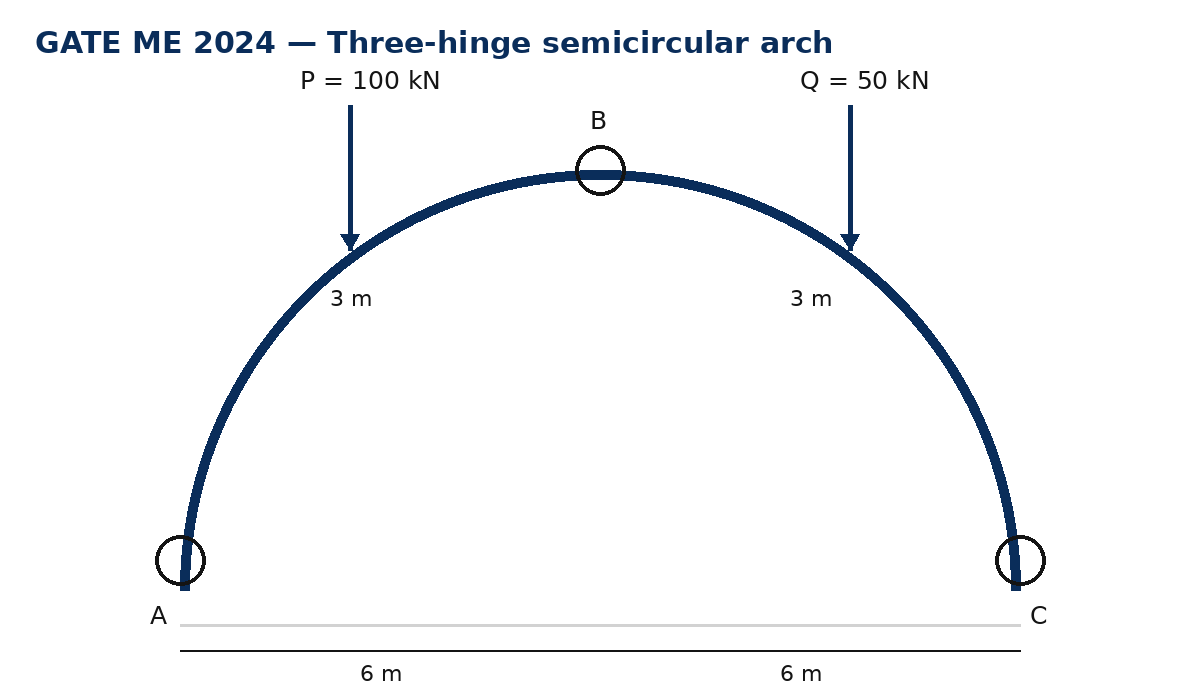
A three-hinge arch ABC in the form of a semicircle is in static equilibrium under vertical loads P = 100 kN and Q = 50 kN as shown. Neglect friction at the hinges. Find the magnitude of the horizontal reaction at the crown hinge B, rounded to one decimal place.
✓ Correct Answer: B
Explanation:
Using equilibrium of the complete arch, Ay×12 = 100×9 + 50×3, giving Ay = 87.5 kN. Taking moments of the left half about B gives Ax×6 = 87.5×6 − 100×3, hence Ax = 37.5 kN. Therefore the horizontal reaction at B has magnitude 37.5 kN. Source: GATE ME 2024 Master Question Paper, Q.58.
Difficulty: intermediateType: numerical
Question 2 of 5
Original Exam: GATE (2022)
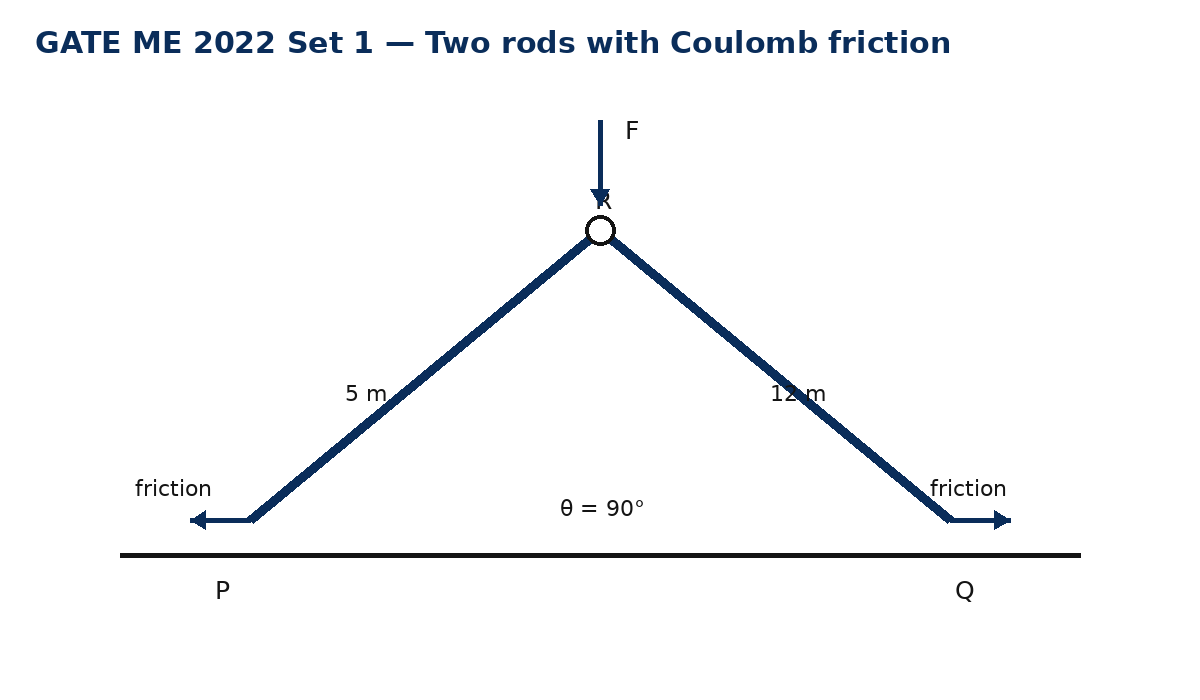
Two rigid massless rods PR and RQ are joined by a frictionless pin at R and rest on rough ground at P and Q. A vertical force F acts at R. The rod lengths from R to P and R to Q are 5 m and 12 m. At an included angle of 90°, impending slip occurs simultaneously at P and Q. Find μQ/μP, rounded to two decimal places.
✓ Correct Answer: C
Explanation:
At θ = 90°, draw separate free-body diagrams for the two rods. Apply horizontal and vertical equilibrium at each rod and use the limiting-friction relations fP = μP NP and fQ = μQ NQ. The resulting ratio is approximately 5.75, which rounds to 5.75. Source: GATE 2022 ME Set-1, Q.50.
Difficulty: intermediateType: numerical
Question 3 of 5
Original Exam: GATE (2022)
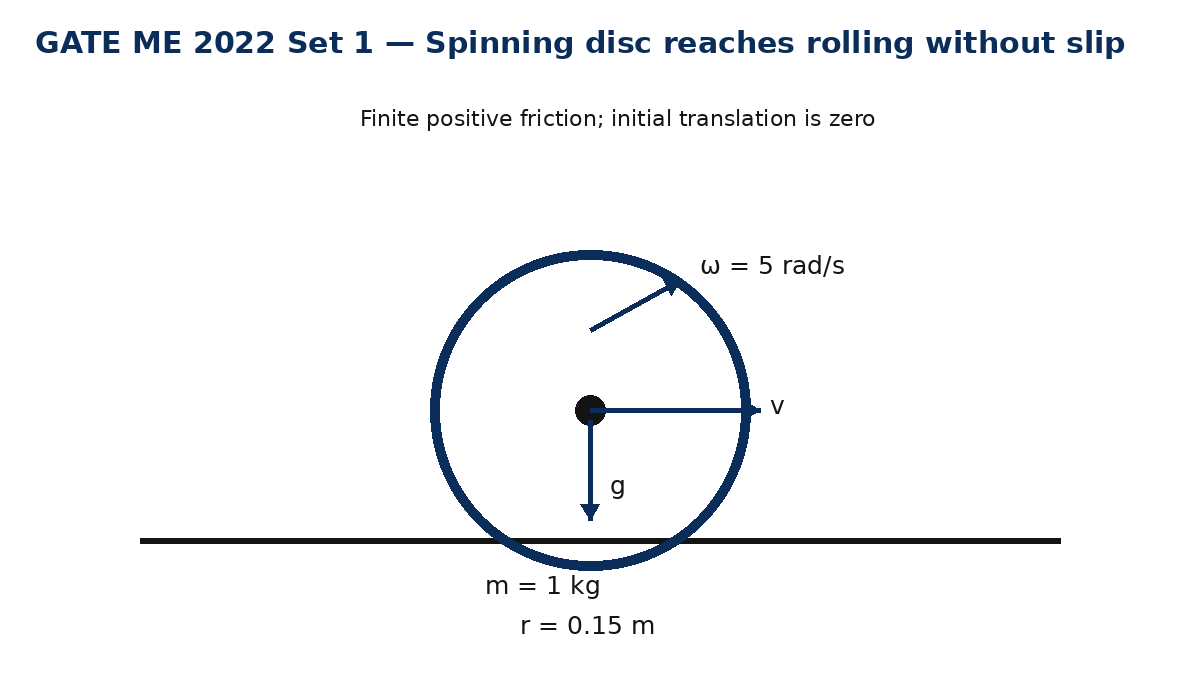
A cylindrical disc of mass 1 kg and radius 0.15 m is initially spinning at 5 rad/s on a horizontal surface and has zero translational velocity. With finite positive friction and no other dissipation, find the horizontal velocity of its centre when it begins rolling without slipping.
✓ Correct Answer: C
Explanation:
For a solid disc, I = (1/2)mr². During slipping, the friction impulse J gives mv = J and I(ω0 − ω) = Jr. At the instant rolling begins, v = rω. Combining these relations gives ω = ω0/3 = 5/3 rad/s and v = 0.15×5/3 = 0.25 m/s. Source: GATE 2022 ME Set-1, Q.51.
Difficulty: intermediateType: numerical
Question 4 of 5
Original Exam: GATE (2022)
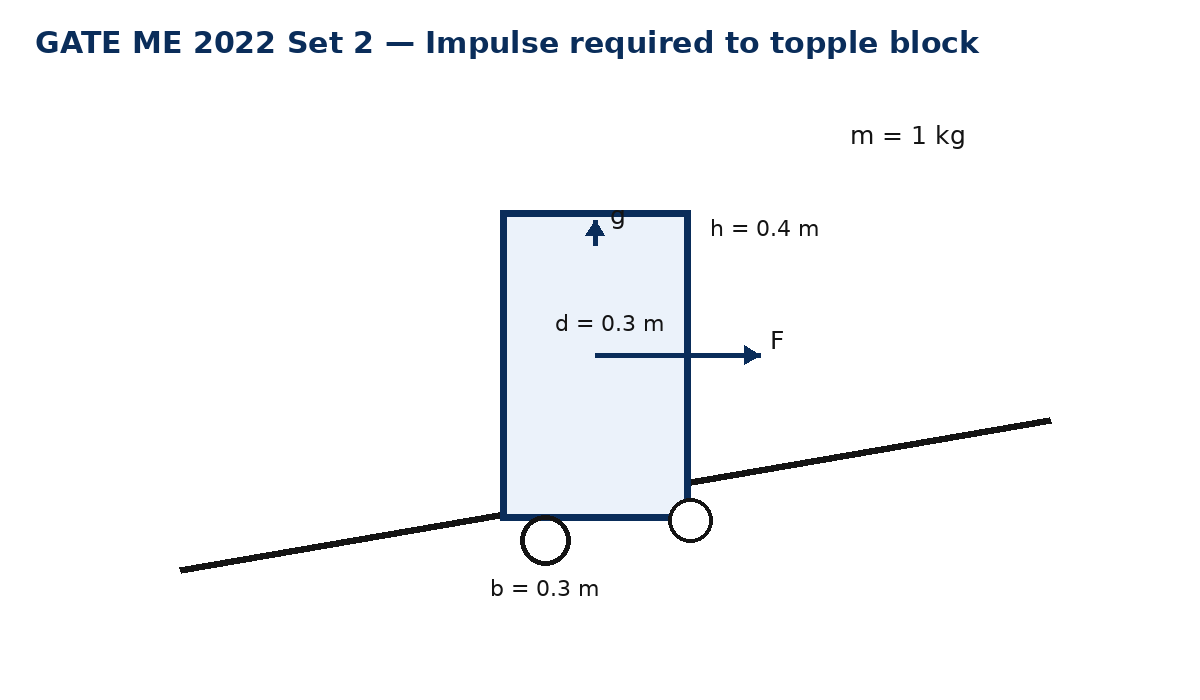
A rigid homogeneous uniform block of mass 1 kg, height h = 0.4 m and width b = 0.3 m is pinned at one corner and supported by a roller as shown. A short-duration horizontal force produces an impulse IF at height d = 0.3 m. With g = 9.81 m/s², find the minimum impulse required to topple the block.
✓ Correct Answer: A
Explanation:
The block rotates about the pin after the impulse. The impulse produces angular momentum about the pin equal to IF·d. The rotational kinetic energy immediately after the impulse must equal the increase in gravitational potential energy needed to bring the centre of mass to the critical toppling position. With m = 1 kg, h = 0.4 m, b = 0.3 m, d = 0.3 m and g = 9.81 m/s², the resulting minimum impulse is approximately 0.953 N·s. Source: GATE 2022 ME Set-2, Q.37.
Difficulty: intermediateType: numerical
Question 5 of 5
Original Exam: GATE (2022)
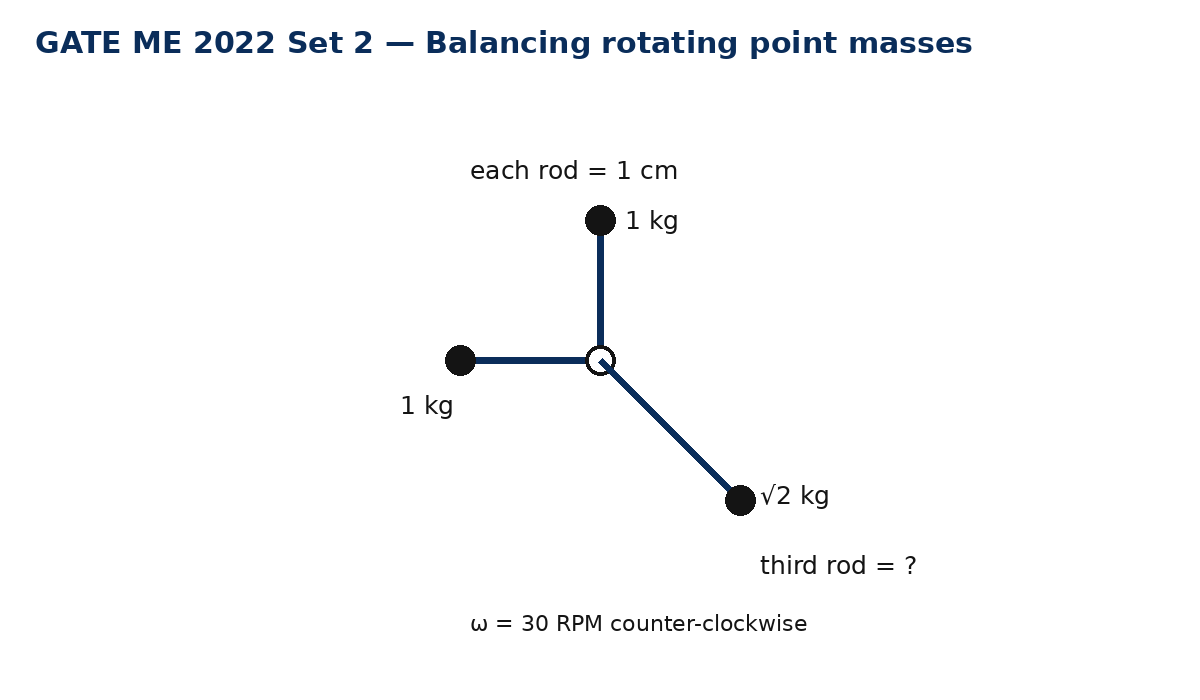
A rigid body consists of two 1 kg point masses attached to the ends of two massless rods, each 1 cm long, as shown. The body rotates about O. A point mass of √2 kg is attached through a third massless rod to balance the rotating body. Determine the required length of the third rod.
✓ Correct Answer: A
Explanation:
Balance the first moment of the two 1 kg masses about O using the √2 kg balancing mass. The resultant of the two equal 1 cm position vectors has magnitude √2 cm. Thus √2 × L = √2 × 1 cm, giving L = 1 cm. Source: GATE 2022 ME Set-2, Q.39.