Analysis of stress and strain for Mechanical Engineering and GATE & IES preparation.
Preparation Mode
31 Active Questions
Answers & Explanations Included
📖 Study the questions before taking the quiz examination.No timer • No attempt recorded • No marks awarded
Question 1 of 31
Original Exam: GATE (2022)
In a tensile test, what quantity is represented by the ultimate tensile strength (UTS) when engineering stress is used?
✓ Correct Answer: A
Explanation:
Engineering UTS is the peak of the engineering stress–strain curve. Engineering stress is P/A₀, where A₀ is the original area. Therefore UTS = P_max/A₀. True stress would instead use the instantaneous area. Source: GATE ME 2022 Set 2.
Difficulty: basicType: conceptual
Question 2 of 31
Original Exam: GATE (2017)
For a perfectly incompressible isotropic linear-elastic material, the Poisson ratio is
✓ Correct Answer: B
Explanation:
For isotropic elasticity, volumetric strain under uniaxial loading is ε_v = ε(1−2ν). Perfect incompressibility requires ε_v=0, hence 1−2ν=0 and ν=0.5. Source: GATE ME 2017 Set 1.
Difficulty: basicType: conceptual
Question 3 of 31
Original Exam: GATE (2017)
A steel bar is fully restrained at both ends. If E = 200 GPa, α = 11×10⁻⁶/°C and ΔT = 100°C, what is the magnitude of the thermal stress?
✓ Correct Answer: C
Explanation:
A fully restrained bar cannot undergo the free thermal strain αΔT. The induced mechanical strain is −αΔT, so σ = EαΔT. Thus σ = 200,000 MPa × 11×10⁻⁶ × 100 = 220 MPa, compressive in nature. Source: GATE ME 2017 Set 2.
Difficulty: intermediateType: numerical
Question 4 of 31
Original Exam: GATE (2015)
A rod experiences a stress change of 200 MPa for a strain change of 0.001. If ν = 0.30, the modulus of rigidity G is approximately
✓ Correct Answer: D
Explanation:
First, E = Δσ/Δε = 200 MPa/0.001 = 200 GPa. For isotropic elasticity, E = 2G(1+ν). Hence G = 200/[2(1.3)] = 76.92 GPa. Source: GATE ME 2015 Set 2.
Difficulty: intermediateType: numerical
Question 5 of 31
Original Exam: GATE (2014)
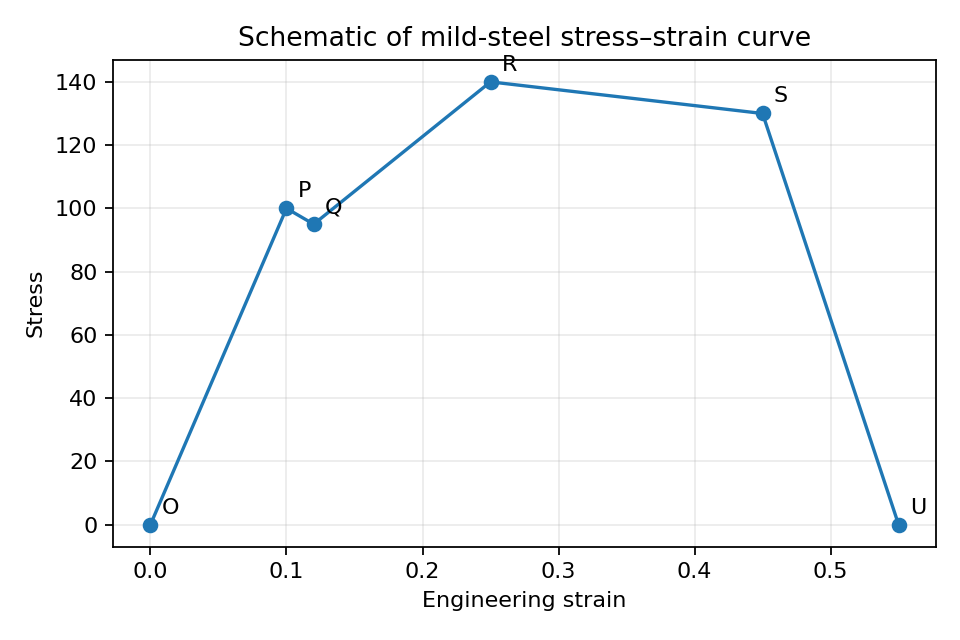
For the mild-steel engineering stress–strain curve used in the examination, which sequence correctly associates the labelled points P–U with the standard material landmarks?
✓ Correct Answer: A
Explanation:
The standard mild-steel curve has proportional limit before the upper yield point, followed by lower yield behavior, then strain hardening to UTS and finally fracture. The option matching those landmarks is the third option. Source: GATE ME 2014 Set 3. A schematic of the curve is supplied separately.
Difficulty: basicType: application
Question 6 of 31
Original Exam: GATE (2014)
A steel cube is heated uniformly while all its faces are free to deform. What hydrostatic pressure is generated solely by the temperature rise?
✓ Correct Answer: B
Explanation:
With all faces free, the cube is able to undergo the free thermal strain αΔT in every direction. No constraint develops, so the thermal stresses and therefore the hydrostatic pressure are zero. Source: GATE ME 2014 Set 2.
Difficulty: basicType: conceptual
Question 7 of 31
Original Exam: GATE (2014)
If an isotropic elastic material has Poisson ratio ν = 0.4, the ratio G/E is
✓ Correct Answer: C
Explanation:
For isotropic elasticity, E = 2G(1+ν). Therefore G/E = 1/[2(1+0.4)] = 1/2.8 = 0.3571. Source: GATE ME 2014 Set 4.
Difficulty: intermediateType: numerical
Question 8 of 31
Original Exam: GATE (2014)
How many independent elastic constants are needed to completely define the linear elastic stress–strain relation of a homogeneous isotropic material?
✓ Correct Answer: D
Explanation:
For an isotropic linear-elastic solid, any two independent constants, such as E and ν or E and G, determine the remaining elastic constants. Therefore the required number is 2. Source: GATE ME 2014 Set 4.
Difficulty: basicType: conceptual
Question 9 of 31
Original Exam: GATE (2014)
A 500 mm long, 50 mm diameter metallic rod elongates by 0.5 mm and its diameter decreases by 0.015 mm under tension. What is Poisson ratio?
A circular rod has one end fixed and the other end free. If its temperature increases by ΔT, which stress–strain combination is correct?
✓ Correct Answer: B
Explanation:
Because the free end can move, the rod is not restrained against thermal expansion. Hence no thermal stress develops, while the thermal strain equals αΔT. Source: GATE ME 2014 Set 1.
Difficulty: basicType: conceptual
Question 11 of 31
Original Exam: GATE (2013)
A prismatic bar carries a tensile load P, but its Young modulus varies along its length. In the absence of distributed axial load, what is the normal stress at any section?
✓ Correct Answer: C
Explanation:
Axial equilibrium requires the internal axial force to equal P at every section. Since the bar is prismatic, area A is constant. Therefore σ=P/A; the varying modulus changes strain ε=σ/E(x), not the axial stress. Source: GATE ME 2013.
Difficulty: intermediateType: conceptual
Question 12 of 31
Original Exam: GATE (2007)
A steel rod is fixed at both ends and heated uniformly by ΔT. For a linear-elastic material, the thermal stress magnitude is
✓ Correct Answer: D
Explanation:
Both ends prevent thermal expansion, so the total strain is zero. Mechanical strain must cancel free thermal strain: ε_m = −αΔT. Hence σ=Eε_m, giving compressive magnitude EαΔT. Source: GATE ME 2007.
Difficulty: basicType: conceptual
Question 13 of 31
Original Exam: GATE (2004)
A slender homogeneous rod rests on a frictionless surface and is heated uniformly. If its radial and longitudinal thermal stresses are σr and σz, respectively, what is the correct relation?
✓ Correct Answer: A
Explanation:
The rod is free to expand on a frictionless surface and is not axially restrained. With no mechanical constraint, no thermal stress develops in either the radial or longitudinal direction. Thus both stresses are zero. Source: GATE ME 2004.
Difficulty: intermediateType: conceptual
Question 14 of 31
Original Exam: GATE (2004)
For an isotropic linear-elastic material, the ratio E/G in terms of Poisson ratio ν is
✓ Correct Answer: B
Explanation:
The isotropic elasticity relation is E=2G(1+ν). Rearranging gives E/G=2(1+ν). Source: GATE ME 2004.
Difficulty: basicType: conceptual
Question 15 of 31
Original Exam: GATE (2003)
Two identical rods carry the same axial tensile force and therefore the same uniform stress. One has E=206 GPa and the other E=100 GPa. Which statement is correct about their axial strains?
✓ Correct Answer: C
Explanation:
Under equal stress in the elastic range, ε=σ/E. Therefore the rod with the smaller modulus, 100 GPa, undergoes the larger strain. The stress is the same because the rods have the same area and carry the same force. Source: GATE ME 2003.
Difficulty: intermediateType: conceptual
Question 16 of 31
Original Exam: GATE (2016)
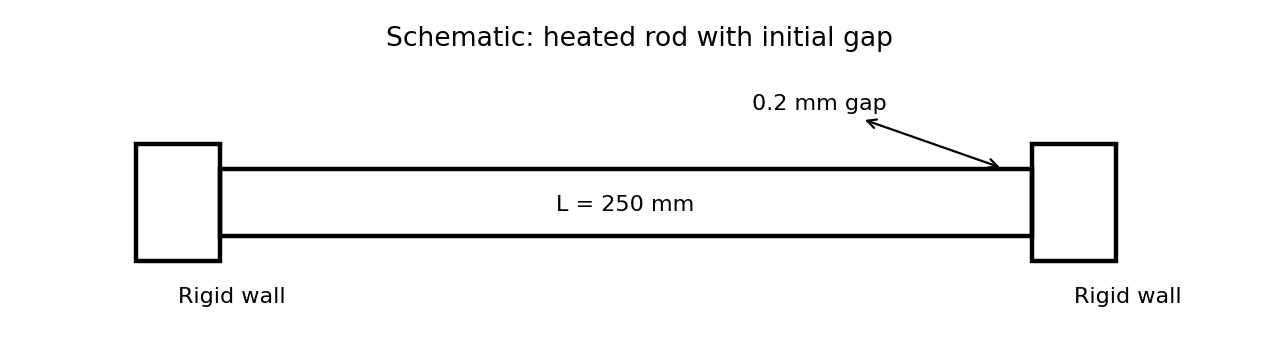
A 250 mm rod is initially 0.2 mm short of a rigid wall. It is then heated by 200°C. With E=200 GPa and α=10⁻⁵/°C, what compressive stress develops after the gap closes?
✓ Correct Answer: D
Explanation:
Free expansion = αLΔT = 10⁻⁵×250×200 = 0.5 mm. Only 0.2 mm is available, so 0.3 mm is restrained. Mechanical strain = 0.3/250 = 0.0012. Stress magnitude = E×0.0012 = 200,000×0.0012 = 240 MPa, compressive. Source: GATE ME 2016 Set 2.
Difficulty: basicType: numerical
Question 17 of 31
Original Exam: GATE (2012)
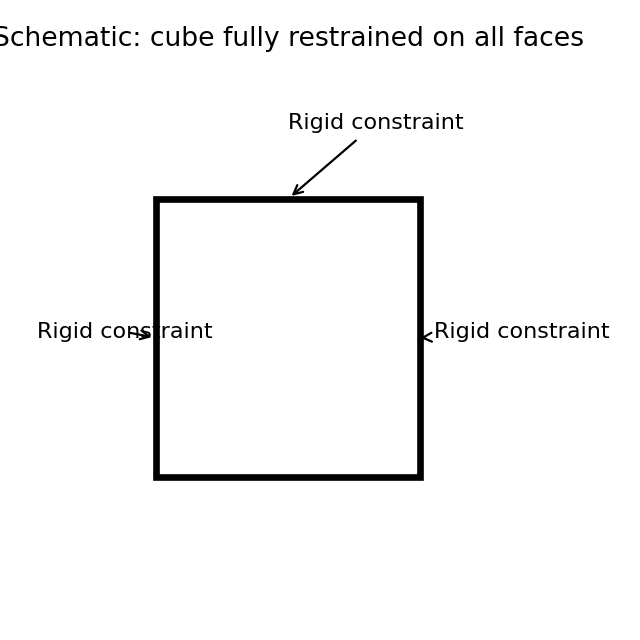
A fully restrained isotropic steel cube is uniformly heated by ΔT. Which expression gives the magnitude of the resulting hydrostatic compressive stress?
✓ Correct Answer: A
Explanation:
For full three-dimensional restraint, each normal strain is zero. Using generalized Hooke law, 0=(1/E)[σ−ν(σ+σ)] + αΔT for equal stresses, giving σ = −EαΔT/(1−2ν). The magnitude is EαΔT/(1−2ν). Source: GATE ME 2012.
Difficulty: basicType: conceptual
Question 18 of 31
Original Exam: GATE (2012)
A 200 mm long stress-free rod is held between immovable walls and heated uniformly by 250°C. If E=200 GPa and α=10⁻⁵/°C, the magnitude of longitudinal thermal stress is
✓ Correct Answer: B
Explanation:
Because the walls prevent expansion, the induced compressive stress magnitude is EαΔT = 200,000 MPa×10⁻⁵×250 = 500 MPa. The rod length does not enter this fully restrained uniform-temperature result. Source: GATE ME 2012.
Difficulty: intermediateType: numerical
Question 19 of 31
Original Exam: GATE (2006)
A 40 mm × 40 mm steel bar of length 2 m is subjected to a compressive load of 200 kN. With E=200 GPa, the decrease in length is
✓ Correct Answer: C
Explanation:
Area A=40×40=1600 mm². Stress = 200,000/1600=125 N/mm². Strain =125/200,000=0.000625. With L=2000 mm, δ=εL=1.25 mm. Source: GATE ME 2006.
Difficulty: intermediateType: numerical
Question 20 of 31
Original Exam: GATE (2023)
A strain-hardening material follows the true stress law σt=400 εt^0.3 MPa beyond yielding. What is the engineering UTS approximately?
✓ Correct Answer: D
Explanation:
For Hollomon behavior, necking begins when the true strain equals the hardening exponent n=0.3. Then σt=400(0.3)^0.3≈278.74 MPa. Convert true strain: e_eng=e^0.3−1≈0.3499. Since σt=σeng(1+e_eng), σeng≈278.74/1.3499≈206.5 MPa. Source: GATE ME 2023.
Type: numerical
Question 21 of 31
Original Exam: GATE (2021)
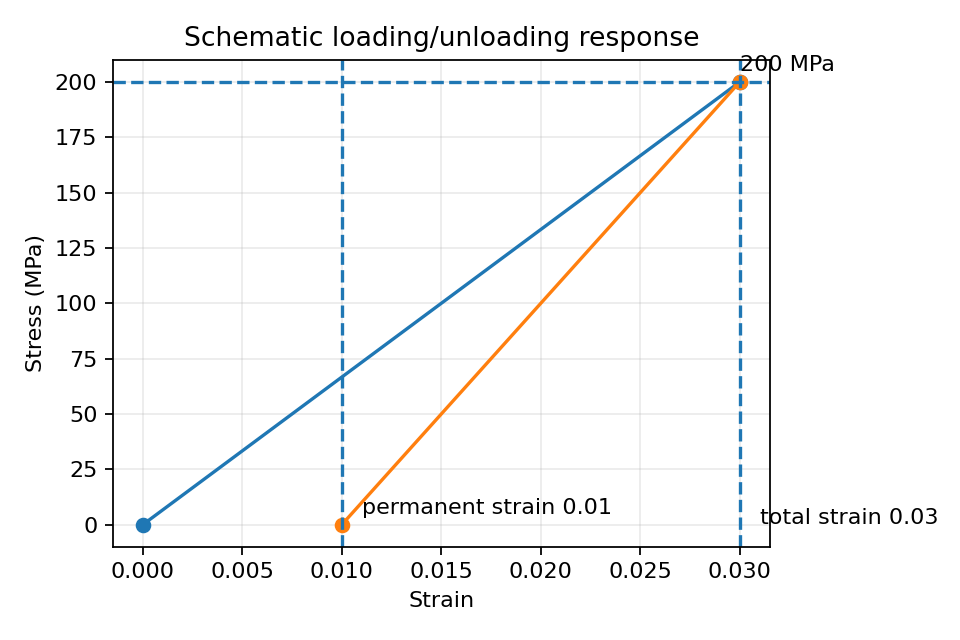
A metal specimen is loaded to 200 MPa and then unloaded. The total strain at 200 MPa is 0.03 and the residual strain after complete unloading is 0.01. The elastic and plastic strain components at 200 MPa are
✓ Correct Answer: A
Explanation:
Plastic strain is the permanent residual strain after unloading: εp=0.01. Elastic strain is the recoverable part, εe=0.03−0.01=0.02. Thus the pair is 0.02 elastic and 0.01 plastic. Source: GATE ME 2021 Set 1.
Difficulty: intermediateType: numerical
Question 22 of 31
Original Exam: GATE (2021)
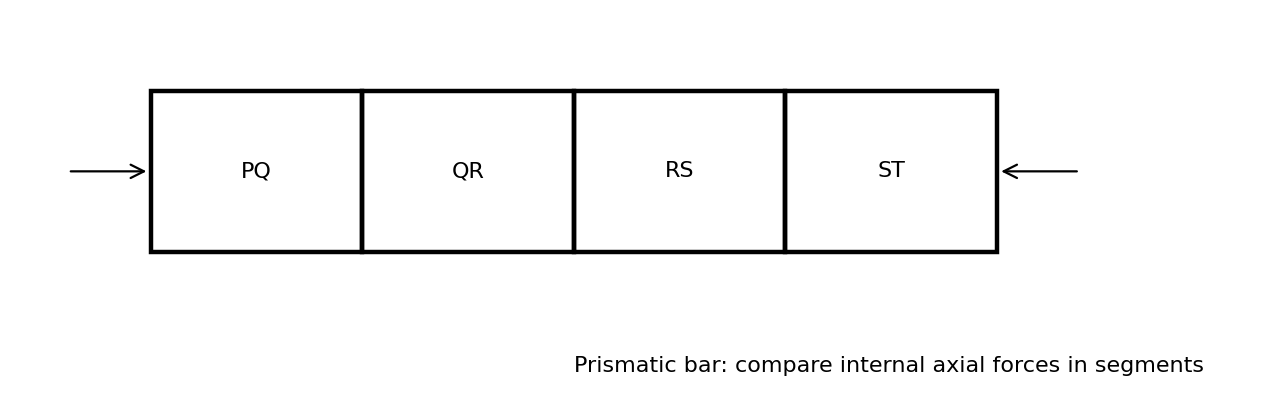
For the prismatic bar PQRST carrying the axial loads shown in the original examination, which pair of segments has the maximum and minimum internal axial stresses, respectively?
✓ Correct Answer: B
Explanation:
Because the bar is prismatic, area is constant and stress magnitude is proportional to the internal axial force. The force balance for the original loading gives the largest internal force in ST and the smallest in RS. Therefore the corresponding stress pair is ST and RS. Source: GATE ME 2021 Set 1.
Difficulty: basicType: application
Question 23 of 31
Original Exam: IES (2020)
In simple uniaxial tension/compression within the proportional limit, the constitutive relation is
✓ Correct Answer: C
Explanation:
Hooke’s law for uniaxial linear elasticity states σ=Eε. Here E is Young’s modulus, σ is normal stress and ε is normal strain. The relation σ=Gγ applies to shear stress and shear strain. Source: ESE Mechanical 2020 Official Paper.
Difficulty: basicType: conceptual
Question 24 of 31
Original Exam: IES (2020)
A 2 m long, 50 mm diameter rod elongates by 5 mm under a 400 kN axial force. The Young modulus is closest to
✓ Correct Answer: D
Explanation:
Area A=πd²/4=1963.5 mm². Using E=PL/(Aδ), E=(400,000×2000)/(1963.5×5)=81.49 GPa. The nearest option is 82 GPa. Source: ESE Mechanical 2020 Official Paper.
Difficulty: intermediateType: numerical
Question 25 of 31
Original Exam: IES (2020)
A copper rod 305 mm long is subjected to 276 MPa tensile stress. If E=110 GPa and deformation is elastic, the elongation is closest to
✓ Correct Answer: A
Explanation:
Elastic strain ε=σ/E=276/110,000=0.002509. Elongation δ=εL=0.002509×305≈0.765 mm. Hence 0.8 mm is the closest option. Source: ESE Mechanical 2020 Official Paper.
Difficulty: intermediateType: numerical
Question 26 of 31
Original Exam: IES (2017)
A bar has lateral strain magnitude 60×10⁻⁵ under a tensile stress of 300 MPa. If ν=0.30, Young modulus is
A steel tensile specimen has initial diameter 12.8 mm, engineering fracture stress 460 MPa, and fracture diameter 10.7 mm. The true stress at fracture is closest to
✓ Correct Answer: C
Explanation:
True stress uses the instantaneous fracture area: σt=σeng(A0/Af)=460(d0/df)². Thus σt=460(12.8/10.7)²≈658.3 MPa, which rounds to 660 MPa. Source: ESE Mechanical 2019 Official Paper.
Type: numerical
Question 28 of 31
Original Exam: IES (2013)
A 16 mm diameter bar elongates by 0.04% under 16 kN tension and its diameter decreases by 0.01%. Which pair is correct?
✓ Correct Answer: D
Explanation:
Longitudinal strain=0.04%=0.0004 and lateral strain magnitude=0.01%=0.0001, so ν=0.0001/0.0004=0.25. Stress=16,000/[π(16²)/4]≈79.58 MPa. Hence E≈79.58/0.0004=198.9 GPa≈199 GPa. Finally G=E/[2(1+ν)]≈79.6 GPa≈80 GPa. Therefore the correct combined statement is E≈199 GPa and ν=0.25; in the original paper this was represented through a statement-combination option. Source: ESE Mechanical 2013 Official Paper 2.
Type: numerical
Question 29 of 31
Original Exam: IES (2017)
A 10 mm diameter mild-steel bar has E=200 GPa and carries 50 kN, producing a stress just beyond yield. The elastic strain recovered on unloading is approximately
✓ Correct Answer: A
Explanation:
Area=π(10²)/4=78.54 mm². Stress=50,000/78.54≈636.6 MPa. The elastic recovery is σ/E≈636.6/200,000=3.18×10⁻³. Source: ESE Mechanical 2017 Official Paper.
Type: numerical
Question 30 of 31
Original Exam: IES (2018)
The resilience of a material is represented on a stress–strain diagram by the area under the curve up to the
✓ Correct Answer: B
Explanation:
Resilience is the energy stored and recoverable within the elastic range. Therefore the relevant area is the area under the stress–strain curve up to the elastic limit. Source: ESE Mechanical 2018 Official Paper.
Difficulty: basicType: conceptual
Question 31 of 31
Original Exam: IES (2014)
For plane stress σx=60 MPa, σy=120 MPa and τxy=40 MPa, the radius of Mohr’s circle is
✓ Correct Answer: C
Explanation:
Mohr-circle radius R=sqrt[((σx−σy)/2)²+τxy²]. Here ((60−120)/2)²=900 and τ²=1600, so R=sqrt(2500)=50 MPa. Source: ESE Mechanical 2014 Official Paper 2.