Fundamentals of phase diagrams for Mechanical Engineering and GATE & IES preparation.
Preparation Mode
9 Active Questions
Answers & Explanations Included
📖 Study the questions before taking the quiz examination.No timer • No attempt recorded • No marks awarded
Question 1 of 9
Original Exam: GATE (2018)
In a binary phase diagram, which reaction represents a eutectoid transformation?
✓ Correct Answer: A
Explanation:
A eutectoid reaction is a solid-state invariant reaction in which one solid phase transforms into two different solid phases. Therefore M1 → M2 + M3 is the correct representation. Traceable to GATE ME 2018 Set-2, Q12.
Difficulty: basicType: conceptual
Question 2 of 9
Original Exam: GATE (2020)
For an equilibrium binary phase diagram, which statement is INCORRECT?
✓ Correct Answer: C
Explanation:
Equilibrium phase diagrams describe stable phases, phase boundaries and equilibrium compositions/amounts. They do not provide transformation kinetics or rates; TTT/CCT diagrams are used for that purpose. Traceable to GATE ME 2020 Set-2, Q7.
Difficulty: basicType: conceptual
Question 3 of 9
Original Exam: IES (2020)
A binary alloy is in a two-phase liquid + solid region. Which rule is used to determine the relative proportions of the two phases at a specified temperature?
✓ Correct Answer: B
Explanation:
The lever rule determines the relative mass or mole fractions of the coexisting phases along a tie line in a binary equilibrium phase diagram. Traceable to ESE Mechanical 2020 official paper.
Difficulty: basicType: conceptual
Question 4 of 9
Original Exam: IES (2014)
Consider these statements about binary phase diagrams: (1) Additional alloying elements can change a binary phase diagram. (2) Tie-line construction and the lever rule are used to determine phase compositions/amounts. (3) Phase diagrams provide transformation-rate information. Which statements are correct?
✓ Correct Answer: A
Explanation:
Statements 1 and 2 are correct. Equilibrium phase diagrams do not give transformation rates; kinetics are treated using TTT/CCT diagrams. Therefore the correct choice is 1 and 2 only. Traceable to ESE Mechanical 2014 Paper-II.
Difficulty: intermediateType: conceptual
Question 5 of 9
Original Exam: IES (2014)
In the Fe–C equilibrium system, the eutectoid transformation is represented by:
✓ Correct Answer: A
Explanation:
At the eutectoid composition and temperature, austenite transforms into ferrite and cementite; the resulting microstructure is pearlite. Traceable to ESE Mechanical 2014.
Difficulty: basicType: conceptual
Question 6 of 9
Original Exam: IES (1995)
In the Fe–C equilibrium diagram, the eutectoid transformation occurs at approximately:
✓ Correct Answer: B
Explanation:
The eutectoid temperature of the Fe–Fe3C system is conventionally taken as about 723 °C in the cited examination question. Traceable to ESE Mechanical 1995.
Difficulty: basicType: conceptual
Question 7 of 9
Original Exam: GATE (2016)
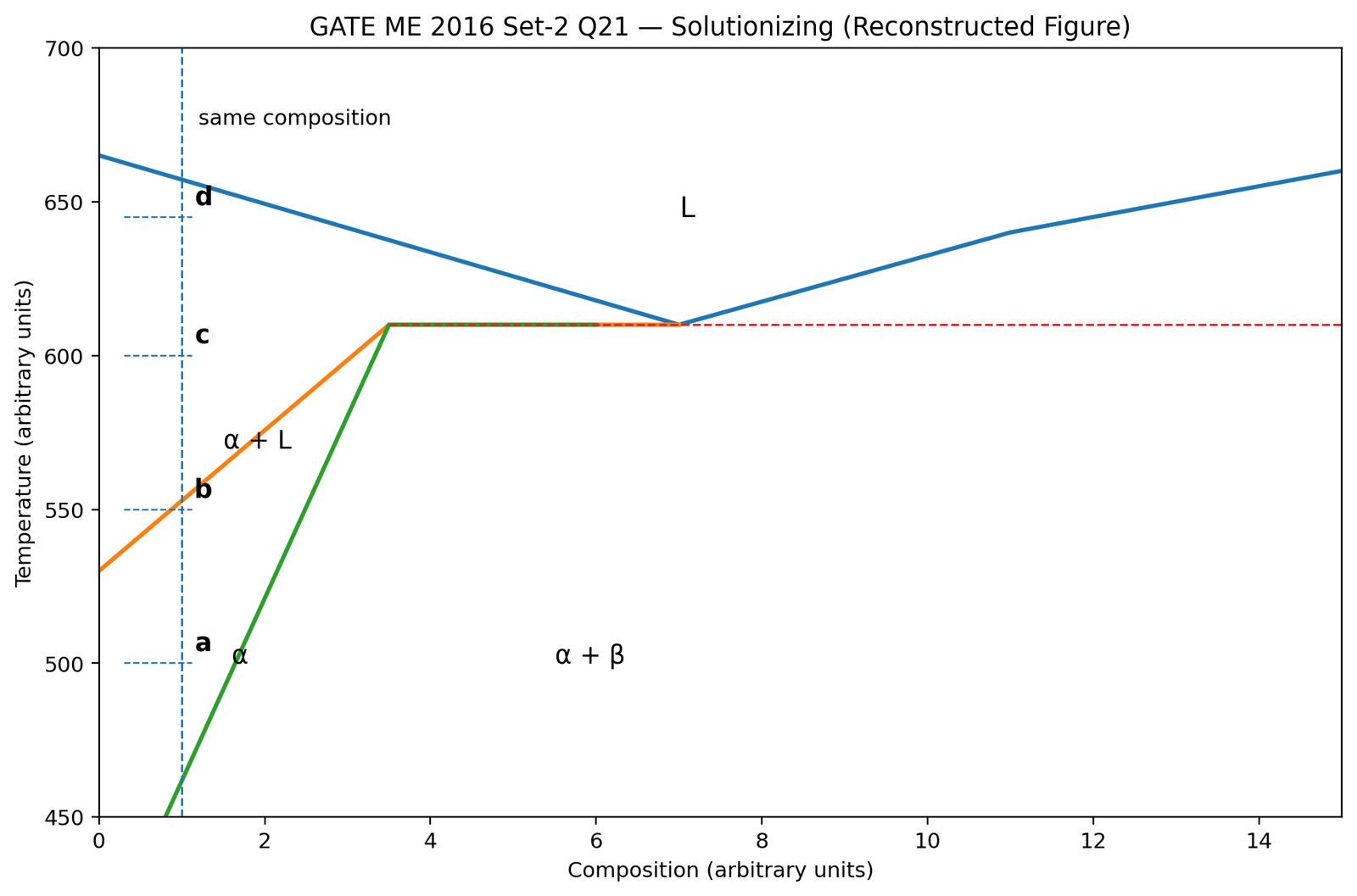
For a binary phase diagram, four samples of the same composition are heated to temperatures marked a, b, c and d in the supplied phase-diagram figure. At which marked temperature does the sample become solutionized fastest?
✓ Correct Answer: C
Explanation:
For solution treatment, the alloy is heated into the appropriate single-phase solid-solution region; among the marked temperatures in the original figure, c gives the fastest solutionizing condition. Traceable to GATE ME 2016 Set-2, Q21. The original question is figure-dependent, so the original figure must be supplied if this item is imported with an image.
Difficulty: intermediateType: conceptual
Question 8 of 9
Original Exam: GATE (2022)
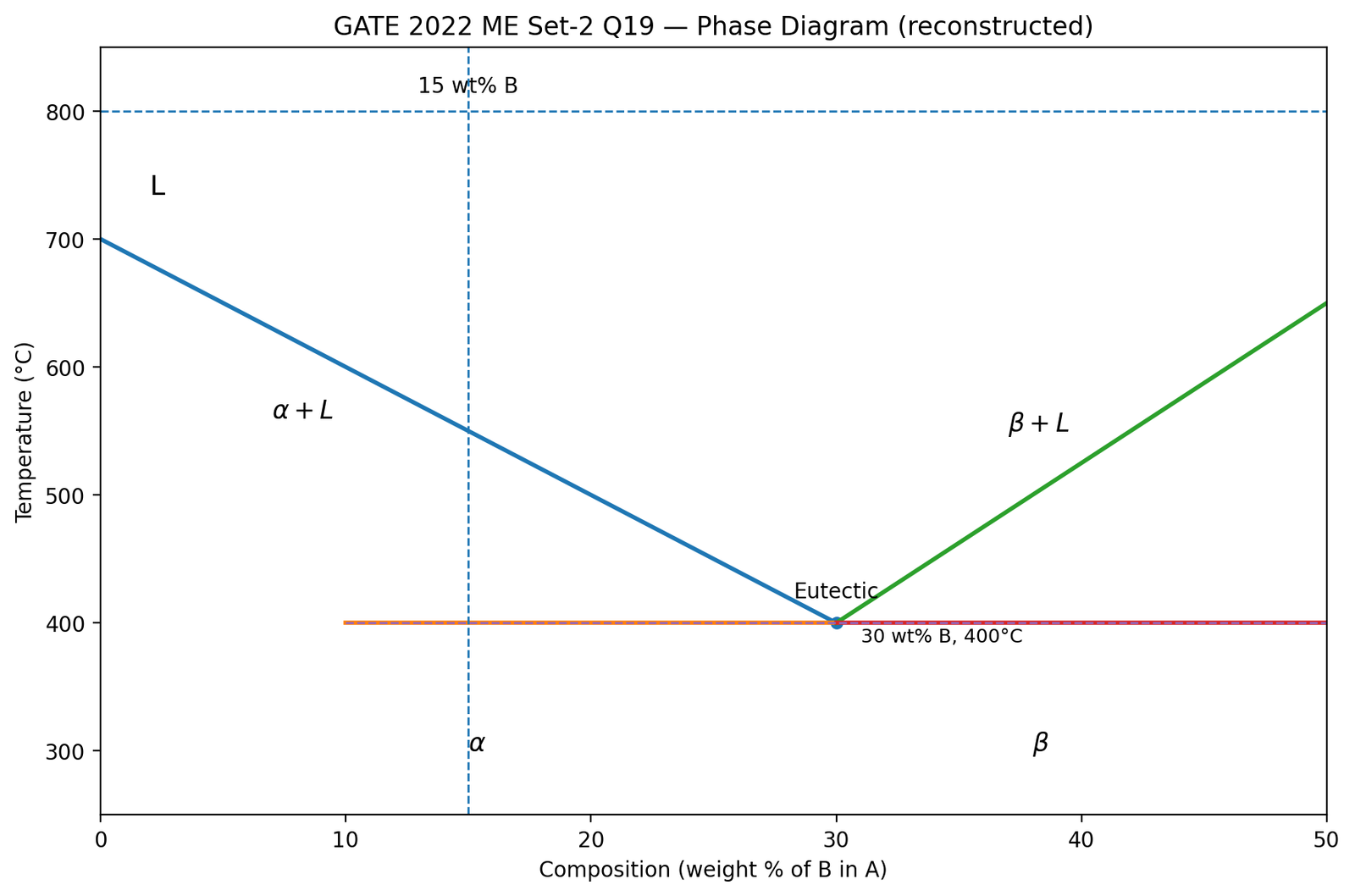
A hypothetical binary alloy has a eutectic point at 30 wt% B and 400 °C. The liquidus from 0 wt% B at 700 °C to the eutectic is straight. For an alloy containing 15 wt% B, the liquidus temperature is 550 °C and solidification ends at 400 °C. What is the solidification range?
✓ Correct Answer: D
Explanation:
At 15 wt% B, linear interpolation on the left liquidus gives TL = 550 °C. The solidification ends at the eutectic temperature, TS = 400 °C. Therefore the solidification range is TL − TS = 550 − 400 = 150 °C. Traceable to GATE ME 2022 Set-2, Q19. The original question contains a phase-diagram figure; the numerical information is retained here so the SSRAO version is self-contained.
Difficulty: intermediateType: numerical
Question 9 of 9
Original Exam: GATE (2024)
In pearlite, the two phases present are:
✓ Correct Answer: C
Explanation:
Pearlite is the eutectoid microconstituent consisting of ferrite (α-iron) and cementite (Fe3C). Traceable to GATE ME 2024 Set-2, Q28.